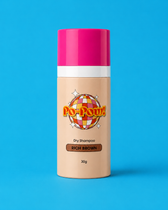
You know the moment. You've got five minutes before you're supposed to be out the door, you reach for the dry shampoo, spray with the confidence of someone who has done this a thousand times — and suddenly your roots look like you've been standing too close to a chalkboard eraser.
It's not your technique. It's the formula.
Most dry shampoos are built on a base of starches (rice, corn, or tapioca) or clays that absorb oil at the root. That part works great. The white cast happens because those absorbent powders are, by default, white — and white powder on anything darker than a light blonde is going to show up, no matter how well you blend it in.
What your root color actually has to do with it
The white cast problem scales with the contrast between your hair color and the powder's color. If you're a level 9 blonde, a white-based formula mostly disappears. If you're anywhere from a medium brown to black — or you're covering greys at the root — that same formula sits on top of your hair like a light dusting of snow.
This is the whole reason tinted dry shampoo exists: instead of one shade of white for every head of hair, the powder itself is pigmented to match a hair color range, so it disappears into your roots instead of sitting on top of them.
How to avoid it, whatever you're using
- Shake it, then keep your distance. Give the can or jar a proper shake and apply from a few inches back — spraying or tapping too close concentrates the powder in one spot.
- Section your roots. Apply in small sections rather than covering your whole head at once.
- Give it a minute. Dry shampoo needs a moment to actually absorb oil before you work it in — rushing the massage-in step is what leaves visible residue behind.
- Match your shade. If you have brown, black, or red hair, a tinted formula built for your root color will save you the blending step entirely.
Bottom line: the white cast isn't a personal failing, it's chemistry. Pick a formula built for your actual roots, and you can skip the hallway hair-brushing panic entirely.